IT TRICK and TIPS

Head Ads

Our Services

  • SEO on Page service
  • Keywords Planning
  • Off Page SEO Complete
  • YouTube SEO Services
  • Social Media Marketing
  • Learn IT Tricks and Tips
  • Learn Programming
  • Website Development
  • Quality Content Writing
  • Website Analysis
  • Website Speed Optimization

Ads2

Related Posts

Showing posts with label Features of PHP programming language. Show all posts

Friday, May 7, 2021

PHP 8: What's new? | Php 8 features

 PHP 8: What's new? | Php 8 features

On November 26, 2020, the PHP 8 release date so the PHP developer the community celebrated the launch of one of the most anticipated versions of the programming language in recent years: PHP 8. So in this article, I will discuss PHP 8 and give the answer to these questions PHP 8 new features, What changed in PHP 8? Is PHP 8.0 stable? and What is new in the latest version of PHP? and this article is a complete PHP 8 review that will give you information about all you need to know about PHP 8. So let's discuss the topic PHP 8 what is new PHP 8 features.  

Php 8 what is new
Php 8 what is new


PHP 8 - Released

It is an important update according to php.net, because it contains "new resources and optimizations that include named arguments, union types, attributes, promotion of constructive properties, match expressions, the nullsafe operator," the much desired JIT compiler, "improvements in the type system, error handling ”, etc, etc ...

The truth is that these new resources excite me, and you? Are you still thinking that PHP is dead, or thinking about the future it has as a programming language?

Let's look at 8 of these new PHP 8 resources together, we will compare how you had to program certain functionality in PHP 7 and how you will do it now in PHP 8.

1. The Nullsafe Operator ( RFC )

One of the problems with the null-merge operator is that it doesn't work on method calls. You need, for example, intermediate checks and if in PHP 7 you had to check for null conditions, which could be infinite and sometimes absurd, now you can use a chain of calls with nullsafe,   and have a behavior similar to null fusion in the methods. If the "evaluation of an element fails, the execution of the entire string is addressed, and the string is evaluated as null".  

Note to self: if this doesn't excite you, you don't need to read on. But look at the example from php.net:

PHP 8 whats new?


Checking for null conditions in PHP 7

PHP 8 what is new


Nullsafe operator in PHP 8


2. Named arguments ( RFC )

Named arguments allow you to pass values ​​to a function, specifying the name of the value. This way you can forget about the order and omit optional parameters. Furthermore, the arguments are automatically documented. Look at the example:

PHP 8 what,s new


Mandatory parameters in PHP 7

Php 8 what's new


Optional parameters with named arguments in PHP 8

PHP 8: What's new?


Another example of optional parameters with named arguments in PHP 8

3. Attributes ( RFC )

Attributes in PHP are what in other languages, or frameworks, are known as annotations . PHP 8 and allows you to add structured metadata with native PHP syntax to classes, instead of PHPDoc annotations. What do you think?

PHP 8: What's new?


Annotations in PHP 7

PHP 8 what is new

Attributes in PHP 8


4 match expressions ( RFC )

Match expressions can be seen as the brother or sister of the switch expression , since they are similar expressions. Match expressions can be stored as variables or returned (they can return values), they don't need interrupt- break trades, they can combine conditions, they do strict type comparisons, and they don't do any kind of coercion. Look at this example:

Php 8 what's new


Switch expression in PHP 7

PHP 8 what's new

Match expression in PHP 8


5. Promotion of constructive properties ( RFC )

The "promotion of constructive properties" adds "syntactic sugar" to create valuables or data transfer objects. Now you can combine class properties and a constructor for them all in one. As you can see in the example below, we are talking about less boilerplate code "to define and initiate a property". How about?

PHP 8 what's new


Properties and constructor in PHP 7

PHP 8 What's new

Properties and constructor in PHP 8


6. JIT compiler (dynamic translations)

The JIT compiler - just in time - promises great improvements at the performance level. But you should know that not always within the context of web requests. With PHP 8 you have 2 JIT compilation engines: Function JIT and Transit JIT , with Transit JIT the one with the best performance, 3 times better in synthetic benchmarks in some types of applications.

Look at the following comparison:

PHP 8 what is new


Comparison of PHP 8 without JIT, with Tracing JIT and with Function JIT


7. Types of union ( RFC )

Union types can be useful in many cases, due to the dynamic type nature of PHP. Union types are a collection of two or more types indicating that either of the two can be used. Instead of combining types in annotations in PHPDoc , you can use a native binding declaration type and this is valid at the time of execution.

PHP 8 Whats new?


Types in annotations in PHPDoc of PHP 7

PHP 8 whats new


Native union type declaration in PHP 8

Note that void can never be part of a union type, as it indicates "no return value".


8. Smart comparisons between strings and numbers ( RFC )

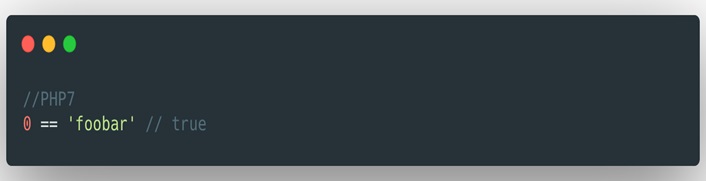
This RFC solves the case where in PHP 0 == “foo” is true. Now when you compare to a numeric string, PHP 8 uses a numeric comparison. If not, convert the number to string and use string comparison.
PHP 8 what is new


Confusing comparison in PHP 7

Php 8 what is new


Smart comparison in PHP 8

The resources discussed in this article are just some of the improvements that PHP 8 brings. There are many others that are worth taking into account, such as:

  • Consistent error types for internal functions
  • Improvements in the type system and error handling
  • Tighter type checks for bitwise / arithmetic operators
  • Validation of the abstract trait method
  • Correct signatures of magic methods
  • Reclassified Engine Warnings
  • Opaque objects instead of resources for Curl, Gd, Sockets, OpenSSL, XMLWriter and XML

I encourage you to review the release notes for PHP 8 on the official PHP site if you want to know in-depth about these new resources.

Conclusion

What do you think of these innovations? The truth is that they seem very interesting and important to me for the future of PHP. Also, I have the feeling that that feeling - forgive the redundancy - of writing a lot of code for simple functionality tends to disappear. What do you think? I hope you understand better about these concepts 8 what is new PHP 8 features,  what is new in PHP 8 all you need to know about PHP 8, PHP 8 release date,  What changed in PHP 8? attribute review. 

However, if you are thinking of using these new resources in your current project, remember that we are talking about a new major version, and you would have to change your code first and adapt it to be able to work in PHP 8. Symfony and Drupal are already working on it, and you? Comment below!


Friday, February 12, 2021

Advantages of PHP programming language | PHP uses and advantages


Advantages of PHP programming language | PHP uses and advantages

Advantages of PHP programming language


In order to describe possible scenarios of use and actions of a particular web application or site, developers use special languages ​​of the so-called web markup. At the same time, program codes working from the server-side or interpreted by the server part allow more efficient use and expansion of the interactive capabilities of a particular resource or project. So in this article, I will discuss the Advantages of PHP programming language. I will cover PHP uses and advantages.

Such programming languages ​​belong to a large group of server-side languages, of which there are quite a few today. Among them are such popular ones as Phyton, Perl, Ruby, C +, ASP, and, of course, PHP. For further details about programing language history read the history of programming.

Despite the fact that technically almost any project can be successfully implemented in any server-side web programming language, the most common, and therefore the main, is the web markup language PHP, in particular, as of today, its fifth version.  

Features and Advantages of PHP programming language

The task of the PHP language is to provide effective communication of a web resource with a server and databases. Moreover, this language is extremely easy to learn and use. Basically, everything you need to know to start learning and programming PHP is the simplest web markup language HTML. PHP goes well with  HTML code. However, one browser is not enough to execute scripts, a web server is required.

Don't know what is difference between coding and programming? Read this article Difference between coding and programming. 

Tasks to be solved

The code written in PHP aims to accomplish two things:

  • HTML-part is responsible for the appearance and display of information;
  • PHP part integrated into HTML provides interactivity and dynamics.

At the same time, such program codes and, accordingly, projects compiled with their help are light, effective, flexible, multifunctional, easy to administer, edit, maintain.

Today the vast majority of sites, services, and applications, as well as such popular platforms as Joomla, Drupal, WordPress, 1C-Bitrix, and UMI.CMS is written in  PHP.

The PHP language has a number of undeniable advantages of PHP programming language:

  • High speed of work and, accordingly, the overall performance of resources.
  • Budget, efficiency. Finding a specialist is not a problem, the cost of writing programs in PHP is not high.
  • Easy to learn, simple syntax.
  • Excellent compatibility and portability - PHP codes work equally well with different platforms.
  • You can type the code and edit it in any text or  HTML editor.
  • High flexibility, capacity, and functionality. A PHP program can be compiled separately from web page development, without binding, and then combined. This greatly simplifies the life of designers and programmers with object-oriented programming. 
  • Multitasking and ample opportunities - creating any web applications, blogs, guest books, online stores, websites, working with redirects, headers, pdf documents, databases, e-mail, etc.

PHP development platforms

PHP has not lost its popularity for many years, despite the abundance of other languages ​​for writing various web applications, services, sites, etc. So, PHP is quite easy to create applications and dynamic sites. In addition, this server-side programming language perfectly integrates with most operating systems and platforms for website development. Among these, the most popular, and, at the same time, already proven, are the following:

  • Free boxed CMS - Joomla, Drupal, ModX, WordPress, ideal for creating simple standardized blogs, shops, business card sites, as well as a number of interactive services;
  • Paid options for boxed CMS - NetCat, Umi.CMS, 1C-Bitrix, often used by developers to create and improve more complex projects;
  • Flexible powerful frameworks - Zend, Symfony, Yii, allowing you to create truly unique projects that are complex and multitasking, as well as designed for high loads.

Advantages of PHP programming language and Disadvantages of Using PHP, Ruby on Rails Framework

PHP-language is supported by the majority of hosting due to its prevalence, good speed, lightness, cross-platform, and functionality.

At the same time, PHP has a growing competitor. We are talking about the Ruby language, which is not yet so widespread, but which has already served to create a convenient flexible, and functional Ruby on Rails framework. "Rails" were created especially for working with Ruby. At the same time, the new framework platform is even easier to master than the programming language itself, if it is not about very complex projects, and therefore this platform is gaining popularity when creating services and applications, as well as such loaded highly visited resources like Twitter, Groupon, Lenta.ru and some others.

Advantages of PHP programming language and Ruby on Rails comparison. 

Ruby on Rails is used in cases where it is necessary for the project to "fly", as it provides a high speed of work. At the same time, as a rule, PHP-programmers who already have sufficient theoretical and practical experience behind them, but want to try something new, go to the category of Ruby programmer.

Thus, the basis for everything is knowledge and the ability to apply HTML and PHP layout. The evolutionary development of PHP, manifested in its high versatility, in some moments played a cruel joke with the language, endowing it with shortcomings, which the more narrowly focused and "sharpened" and functional Ruby on Rails lacks.

Customer review on PHP and Ruby on Rails 

From the point of view of the customer, the creation of PHP code, as well as launching, debugging, editing, expanding, maintaining such a project will be cheaper. However, you should be prepared for the fact that, given the high complexity of the tasks set for the website being developed, you will have to include in the expense items the fixed costs of finding experienced PHP developers, because they are really hard to find due to the "low entry threshold" for this language, and as a result of the huge number of pseudo-specialists in the web programming market. If we take a long period of time, then the costs for a solution made in PHP will be noticeably higher than, for example, for a solution implemented in Ruby on Rails.


PHP Programming Language | Features of PHP programming language


PHP Programming Language | Features of PHP programming language

PHP programming language


Introduction to PHP Programming Language

PHP is a server-side code general-purpose programming language originally designed for dynamic content web development. It was one of the first server-side programming languages ​​that could be embedded directly into the HTML document instead of calling an external file to process the data. The code is interpreted by a web server with a PHP processor module that generates the resulting web page. PHP has evolved so now it also includes a command-line interface that can be used in standalone graphical applications. It can be used on most web servers as well as almost all operating systems and platforms at no cost.

PHP is considered one of the most flexible, powerful, and high-performance languages ​​known to this day, which has attracted the interest of multiple sites with high traffic demand, such as Facebook, to opt for the same as a server technology.

Who created PHP Programming Language? 

History of programming language PHP  was originally created by Rasmus Lerdorf in 1995. Currently, the language continues to be developed with new functions by the PHP group.1 This language is part of the free software released under the PHP license, which is incompatible with the GNU General Public License due to the restrictions on the use of the term PHP.

Features of PHP programming language

Characteristics

  1. Oriented to the development of dynamic web applications with access to information stored in a database.
  2. It is considered an easy language to learn since in its development different specifications were simplified, as is the case of the definition of primitive variables, an example that becomes evident in the use of PHP arrays.
  3. The source code written in PHP programming language is invisible to the web browser and the client since it is the server that is responsible for executing the code and sending its HTML result to the browser.
  4. Ability to connect with most of the database engines that are used today, highlights its connectivity with MySQL and PostgreSQL.
  5. Ability to expand its potential using modules (called ext's or extensions).
  6. It has extensive documentation on its official website, among which it stands out that all the system functions are explained and exemplified in a single help file.
  7. It is free, so it is presented as an easily accessible alternative for everyone.
  8. It allows applying object-oriented programming techniques.
  9. It does not require the definition of variable types although its variables can also be evaluated by the type they are handling at runtime.
  10. It has exception handling (since PHP5).
  11. Although PHP does not force its user to follow a certain methodology when programming, even when doing so, the programmer can apply any programming or development technique to his work that allows him to write orderly, structured, and manageable code. An example of this is the developments that have been made in PHP of the Model View Controller (MVC) design pattern, which allow separating the treatment and access to data, the control logic, and the user interfaces into three independent components.
  12. Due to its flexibility, it has been widely accepted as the base language for WEB content management applications, and it is its main use.

Drawbacks of PHP programing language 

  1. As it is a language that is interpreted in execution, for certain uses it can be inconvenient that the source code cannot be hidden. Obfuscation is a technique that can make code difficult to read but does not necessarily prevent code from being examined.
  2. Because it is an interpreted language, a PHP script usually works considerably slower than its equivalent in a low-level language, however, this inconvenience can be minimized with both file and memory caching techniques.
  3. Inversions prior to 7, the variables are not typed, which makes it difficult for the different IDEs to offer assistance for typing the code, although this is not really a drawback of the language itself. This is solved by some IDEs by adding a comment with the type to the declaration of the variable.

Also read this related article:  What is computer programming?